
Multi-Parameter Disinfection Monitoring in China’s Water Bottling Industry
China is the largest bottled water market in the world. Nong Fu Spring alone — the country’s dominant producer — ships billions of units annually, and the broader sector encompasses hundreds of regional and independent bottlers supplying a population with one of the fastest-growing bottled water consumption rates globally. At that scale, water safety is not simply a quality issue. It is a matter of public health, regulatory compliance, and brand reputation operating simultaneously and at extraordinary volume.
Disinfection is central to safe water bottling — and monitoring that disinfection accurately, consistently, and at pace is what separates a well-run operation from one that is simply hoping the chemistry is working.
Disinfection in Water Bottling: A Multi-Chemistry Challenge
Unlike some food processing applications where a single disinfectant chemistry dominates, water bottling operations typically rely on a combination of agents at different stages of the process. Ozone is widely used for final water treatment — particularly in large-scale Chinese operations including Nong Fu Spring — valued for its effectiveness against microbiological contamination and its ability to degrade without chemical residue. Chlorine (Cl) is applied for source water treatment and equipment sanitation. Peracetic acid (PAA) is used in packaging sterilisation and line cleaning. And hydrogen peroxide features in aseptic filling systems where high-level sterilisation of packaging materials is required.
Each of these chemistries operates within a specific effective concentration range, and each degrades at a different rate depending on temperature, organic load, and process conditions. Managing all of them accurately — across multiple monitoring points, across multiple shifts, in a facility producing millions of units — is not something traditional titration methods are equipped to do reliably.
Regulatory Expectations in the Chinese Bottled Water Sector
China’s bottled water industry operates under strict national standards, including GB 19298, the mandatory safety standard for packaged drinking water. Producers are required to demonstrate microbiological control throughout the production process, and disinfection monitoring records are a standard component of food safety management system audits.
For facilities supplying retail chains, international brands, or export markets, the documentation requirements are even more demanding. Third-party certification schemes such as FSSC 22000 and BRC Global Standards require documented evidence of critical control point monitoring — which in water bottling means timestamped, operator-independent records of disinfectant concentration at every key stage of the process.
How the Palintest Kemio Range Addresses the Challenge
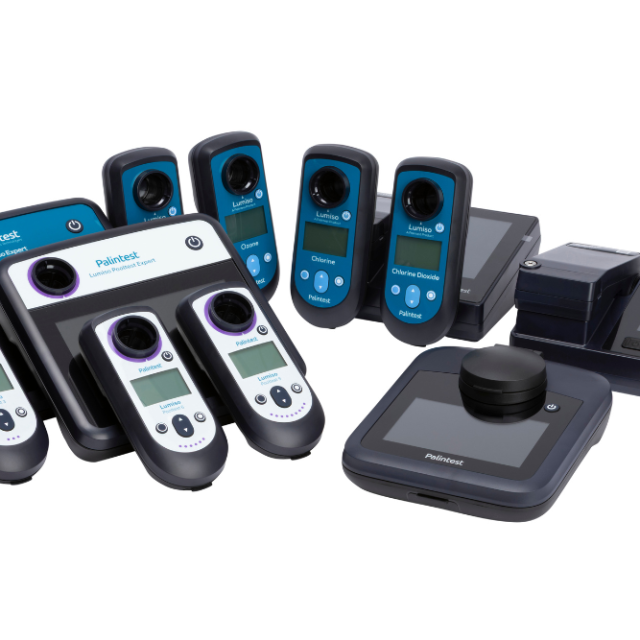
The Palintest Kemio range uses electrochemical, pre-calibrated, single-use sensors to deliver fast, accurate results across the primary chemical disinfectants used in Chinese water bottling: chlorine and PAA. For ozone monitoring, the Palintest Lumiso Ozone provides rapid, accurate analysis up to 3mg/L with USB data logging — purpose-built for food and beverage production environments. Together, Kemio and Lumiso Ozone cover every key disinfection parameter across the production line with documented, timestamped results.
Results are delivered in seconds and require no specialist training or reagent preparation. For a large-scale bottling facility running continuous production across multiple shifts, this means testing can be integrated into normal line operations rather than being treated as a separate laboratory task. It also means that the frequency of testing can match what the process actually requires — not what the testing method makes practical.
Digital result storage and export capability means that every test result is automatically captured with a timestamp and operator record. For compliance purposes — whether for domestic audit, international certification, or customer due diligence — that data is available immediately and in a format that meets the expectations of any modern food safety management system.
One Device. Every Chemistry. Every Shift.
The complexity of disinfection monitoring in water bottling is not going to decrease. As production volumes grow, regulatory expectations tighten, and multi-chemistry CAF processes become standard, the case for a single, reliable, electrochemical monitoring solution becomes stronger — not weaker.
For Chinese water bottlers operating at the scale this market demands, the Palintest Kemio range offers something that titration simply cannot: the speed, consistency, and documented proof that modern water safety requires. In a sector where public trust is the product, that is not a marginal gain. It is the standard.
Frequently Asked Questions
What disinfectants are used in commercial water bottling operations in China?
Chinese water bottling facilities typically rely on a combination of disinfection approaches. Ozone is widely used for final water treatment, particularly among large-scale producers, due to its effectiveness and absence of chemical residue. Chlorine (Cl) is applied for source water and equipment sanitation, peracetic acid (PAA) for packaging sterilisation and line cleaning, and hydrogen peroxide in aseptic filling systems. Each chemical disinfectant operates within a specific effective concentration range and requires accurate monitoring to be both effective and compliant.
What are the key regulatory standards for bottled water production in China?
The primary mandatory standard for packaged drinking water in China is GB 19298, which sets out microbiological, chemical, and process requirements for bottled water producers. Facilities supplying retail chains or export markets may also be required to meet international certification standards such as FSSC 22000 or BRC Global Standards, both of which require documented evidence of critical control point monitoring throughout production.
Why is multi-parameter monitoring important in water bottling?
Different chemistries are used at different points in the water bottling process, and each has its own effective concentration range and degradation profile. The Palintest Kemio range covers chlorine, PAA, and hydrogen peroxide with a single electrochemical device, while the Palintest Lumiso Ozone handles ozone monitoring up to 3mg/L — ensuring every key parameter across the production line can be tested quickly, consistently, and with a documented result.
How does Kemio improve on titration for high-volume water bottling operations?
Titration is slow, requires trained operators, and produces results that can vary between individuals. In a high-volume bottling facility running continuous production, those limitations mean testing is often carried out less frequently than the process demands. The Palintest Kemio range uses electrochemical sensors to deliver results in seconds, with no training or reagent preparation required — making it practical to test as frequently as the line requires, not as frequently as the method allows.
Can Kemio data be used for regulatory audit and certification purposes?
Yes. The Palintest Kemio range stores all results digitally with timestamps and operator records, creating an audit-ready trail of disinfection monitoring data across the production process. This data can be exported to support compliance with GB 19298, FSSC 22000, BRC, and other food safety management frameworks. For facilities where documentation requirements are increasing — particularly those supplying international customers or operating under third-party certification — Kemio’s data logging capability is a direct operational benefit.