
Environmental Water Testing and River Monitoring in the UK
Advancing Environmental Water Testing: Building Trust Through Better River Monitoring
Across the UK, the urgency of advancing environmental water testing and river monitoring in the UK has never been greater. From the River Wye lawsuit over agricultural pollution to the deployment of real-time monitoring buoys in the Coquet Estuary, water quality is dominating both policy and public debate. DEFRA’s recent Working Together for Water fund — distributing £11 million across 51 catchment partnerships — reflects this national priority. In this context, Palintest plays a crucial role in advancing environmental water testing and river monitoring efforts across the UK.
The health of Britain’s rivers has become a litmus test for environmental progress. But beyond the headlines and the funding announcements, a more technical challenge is emerging: how can we ensure that the data behind our decisions is accurate, defensible, and trusted by all stakeholders?
That is where environmental water testing and river monitoring technologies play an essential role. Portable, field-ready instruments capable of laboratory-grade precision are no longer luxuries; they are the foundation of credible environmental governance. This article explores how recent developments are reshaping the UK’s approach to river management, and how Palintest’s testing solutions are helping bridge the gap between science, policy, and public confidence.
The New Landscape of Environmental Water Testing
Environmental testing has evolved dramatically over the past decade. Where once river monitoring relied on periodic sampling and delayed laboratory analysis, today’s environmental science demands immediacy, accuracy, and transparency.
Recent developments highlight this transformation. The landmark River Wye lawsuit, involving thousands of residents taking action against major poultry producers and a water company, has shown that water monitoring is now a matter of legal defence as much as environmental compliance. Meanwhile, DEFRA’s funding for these 51 catchment partnerships across England demonstrates the government’s commitment to improving water quality through collaboration between farmers, researchers, and local authorities. Central to these projects is the expectation of consistent, verifiable data — the kind that only robust testing can provide.
In Northumberland, the Coquet Estuary project offers a glimpse into the future of environmental monitoring. Newly deployed buoys now collect continuous data on oxygen levels, turbidity, and temperature, with results used to inform both conservation efforts and public awareness. This blend of science and community engagement represents a new model for river monitoring — one that depends on accessible, accurate, and real-time data.
Together, these examples point to a single trend: environmental water testing is moving closer to the field, supported by technology capable of withstanding variable conditions while producing reliable, reproducible results.
Challenges in Modern River Monitoring
Monitoring natural rivers presents far greater complexity than controlled systems like drinking water networks or treatment plants. Rivers are dynamic environments, influenced by weather, land use, and human activity. The key challenge lies in capturing this variability while maintaining scientific rigour.
High turbidity and fluctuating sediment loads can distort optical readings, while sudden changes in nutrient or metal concentrations often occur after rainfall or agricultural runoff. In addition, maintaining data consistency across multiple sampling sites and teams remains difficult — particularly when testing is shared between different organisations. Finally, increased public and legal scrutiny demands that all monitoring data is traceable, defensible, and backed by robust quality assurance.
Meeting these challenges requires a combination of reliable methodology and field-proven technology. This is where Palintest’s long-standing expertise in portable water testing provides a clear advantage, offering instruments designed to deliver accuracy and traceability even in the most challenging field conditions.
Practical Solutions: Palintest Technology in Action
At its core, environmental water testing depends on one principle — confidence in the data. Palintest’s technologies are designed to provide exactly that: accuracy under pressure, portability in the field, and traceability from source to report. Three key solutions stand out in the context of river monitoring.
Turbidity Expert from Palintest
Turbidity is one of the most important — and most challenging — parameters in environmental water testing. It measures suspended matter such as silt, algae, and organic material, which can fluctuate rapidly due to rainfall, erosion, or discharge events. High turbidity affects aquatic life, obscures pollutants, and complicates chemical analysis, making accurate measurement essential.
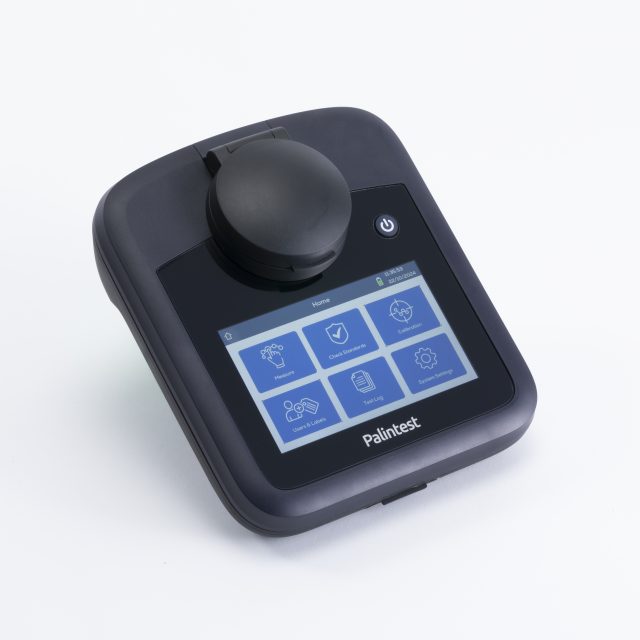
Turbidity Expert from Palintest provides precise, repeatable readings even in cloudy or sediment-heavy conditions. Its durable optical system ensures reliable results under real-world river conditions, supporting catchment teams tracking sediment after storms, regulators monitoring agricultural or construction impacts, and local groups involved in community river monitoring.
By delivering consistent, traceable data directly in the field, the Turbidity Expert helps professionals move from observation to action — forming the foundation for credible, defensible water quality management.
Lumiso Expert Photometer Range
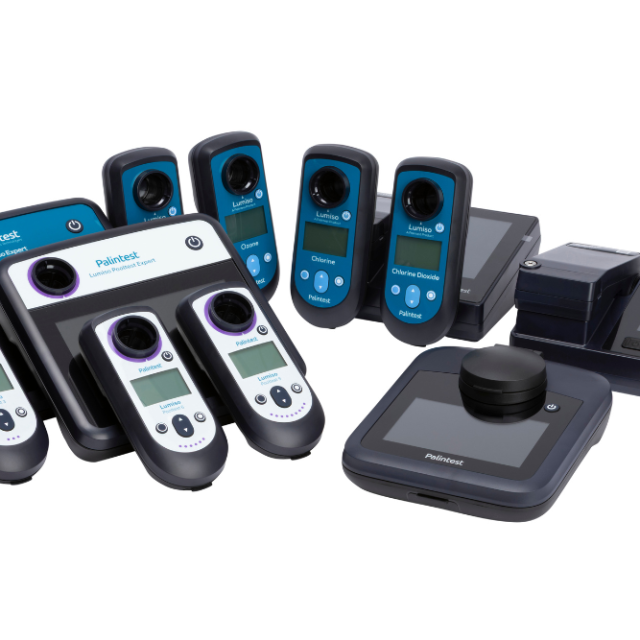
Beyond turbidity, rivers carry a complex chemical signature — nitrates, phosphates, iron, ammonia, and other parameters that determine water health. The Lumiso Expert photometer range enables rapid, multi-parameter testing of these indicators, combining portability with laboratory-grade precision.
Its reagent-based testing system is ideal for analysing nutrient pollution, identifying eutrophication risk, and comparing upstream and downstream samples near discharge points. Crucially, the digital interface provides traceable records, simplifying both data management and reporting.
Whether used by water companies, councils, catchment partnerships, or research teams, Lumiso Expert helps ensure that chemical analysis can be performed in the field — speeding up response times and improving the quality of decision-making.
Kemio Disinfection
For comprehensive fieldwork, particularly in remote areas, Kemio Disinfection delivers a full suite of analytical capabilities for multi-parameter water testing. It enables users to measure multiple physical and chemical parameters on-site, reducing reliance on external laboratories and allowing faster intervention.
Designed around the principle of “Simpler, Safer, Shorter,” Kemio delivers rapid, digital results with minimal reagents, ideal for use in both laboratory and field conditions. Its advanced digital technology ensures accuracy even in turbid samples, with GPS-enabled traceability for full data confidence.
The Kemio ammonia sensor replaces traditional hazardous ammonia testing methods, making environmental analysis safer and simpler. This innovation is particularly valuable for large-scale, multi-agency projects such as DEFRA’s Working Together for Water initiative, where consistent, defensible field data supports collaboration between government, research, and community partners.
Together, these solutions provide the technical foundation for modern river monitoring: accurate, portable, and defensible testing that stands up to scientific, legal, and public scrutiny.
Embedding Science in Policy and Practice
With growing media attention and political investment, there is pressure not just to collect data, but to communicate it effectively. Environmental water testing can only achieve impact when the results are transparent, comparable, and accessible.
To achieve this, organisations should:
- Standardise testing protocols across catchment partnerships to ensure consistency.
- Integrate field data with centralised digital systems, maintaining full traceability and reducing manual errors.
- Adopt event-based sampling, focusing on rainfall or seasonal runoff periods where pollution spikes are most likely.
- Engage local communities in simplified monitoring schemes, building ownership and awareness.
This approach aligns with DEFRA’s partnership model, where environmental improvements depend on collaboration between government, farmers, local authorities, and industry. Palintest’s portable testing technologies directly support this structure — providing a scientific backbone to shared action.
The Future of Environmental Water Testing
As climate change amplifies flood events and alters hydrological patterns, environmental water testing will become even more critical to managing risk and resilience. Real-time sensor networks, IoT-enabled devices, and predictive analytics will complement traditional field testing — but portable, physical testing will remain the cornerstone of validation and trust.
Legal accountability, as seen in the Wye case, and growing community involvement, as seen in the Coquet estuary project, are driving a new era of environmental transparency. Data is no longer just a compliance requirement; it is a foundation for credibility. Palintest’s technologies are designed for precisely this environment — empowering professionals to measure accurately, report transparently, and act decisively.
Environmental Water Testing
The shift toward evidence-based environmental action is irreversible. From the smallest tributaries to major rivers, accurate and transparent environmental water testing underpins every policy, partnership, and remediation effort.
As river monitoring becomes both a legal obligation and a moral imperative, the ability to generate reliable field data has never been more valuable. Instruments like the Turbidity Expert, Lumiso Expert, and Kemio Disinfection enable teams to move from observation to insight — transforming monitoring into measurable impact. The Kemio ammonia sensor also replaces traditional hazardous ammonia testing methods, making field analysis safer and simpler. Designed around the principle of ‘Simpler, Safer, Shorter’, Kemio delivers rapid, digital results with minimal reagents, ideal for use in both laboratory and field conditions.
For governments, researchers, and communities alike, the message is clear: robust testing isn’t just about compliance — it’s about trust, transparency, and the health of the rivers that sustain us all.