
How Does Kemio Work? The Technical Summary
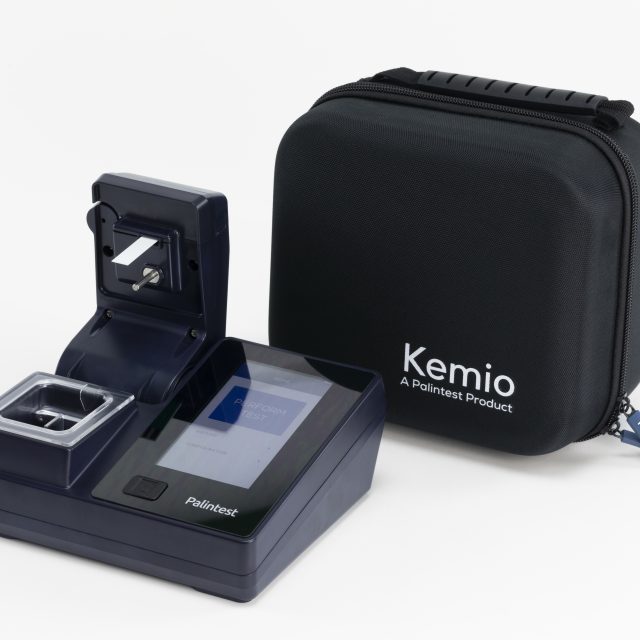
Kemio is our innovative water analysis platform providing expert measurement for disinfectants and heavy metals in water. It is powered by patented, single-use sensors which measure the small changes in current caused by reactions on the surface of the sensor in the water sample. Kemio measures this electrical signal to determine the concentration of chemical or heavy metal within the sample. Find out below how Kemio works.
How is a Kemio sensor designed?
Kemio sensors utilise screen printed Carbon has high electrochemical activity, high chemical stability and screen-printed carbon can be manufactured at a large scale, making it perfect for use with Kemio sensors.
The sensors are made up of three different types of electrodes. They consist of two working electrodes, a counter electrode, and a reference electrode. The top end of the sensor is the interface which connects the sensor to the Kemio instrument.
Our sensor design can be adapted to test for different parameters. Kemio Disinfection can test bromine, chlorine, chlorine dioxide, chlorite and peracetic acid (PAA).
What is the three-electrode system?
The three-electrode system is a classic electrochemical system adapted by Kemio for use with disposable sensors to measure a variety of disinfectant parameters. The three electrodes work together in this system as follows:
Working electrode – A potential is applied between the working electrode and the reference electrode. This is where the electrochemical reaction takes place.
Reference electrode – Much like a blank in photometry, this electrode maintains a steady potential from which the working electrode potential is applied.
Counter electrode – Ensures the potential applied to the working electrode remains the same as the test progresses.
How does a Kemio sensor work?
A mediator is dosed onto the sensor for selectivity. The indicator used varies depending on the analyte that the sensor is measuring. One of the disinfectants Kemio™ can measure is peracetic acid (PAA). Using PAA as an example, this diagram gives a closer look at the chemical reactions taking place at the surface of the sensor.
Electrons flow from the sensor to the tri-iodide ion, and those electrons are measured as current by the instrument.
Palintest sensors are dosed with a pH buffer which is dried on to the sensor surface and will control the pH of the water sample close to the surface of the sensor. This means the addition of strong acid to water samples is not usually required.
How does chronoamperometry work?
Kemio sensors are used in conjunction with the Kemio instrument to measure analyte concentrations in water samples. The Kemio™ instrument uses an electrochemical technique known as chronoamperometry.
The graph shows how this method works. A fixed potential is applied to the electrodes and the resulting current is measured over time. Different concentrations of analyte will return different current values.
The signal which is measured is an electrical current, and therefore the method is unaffected by issues which are an issue for photometric methods, such as sample colour and turbidity.
How does Anodic stripping voltammetry work?
Anodic Stripping Voltammetry (ASV) is an electroanalytical technique that involves the deposition of target heavy metal onto an electrode surface followed by its oxidation and stripping from the electrode.
Kemio measures the current which is correlated to the concentration of heavy metals in the water sample. ASV stands out as a reliable electroanalytical method, and when coupled with Kemio, a cutting-edge analytical platform, it offers unparalleled capabilities in trace analysis of heavy metals in parts per billion (ppb) range with 3-5 minutes.
Sign up for our newsletter
Please add your details below to receive our monthly newsletter and latest offers.