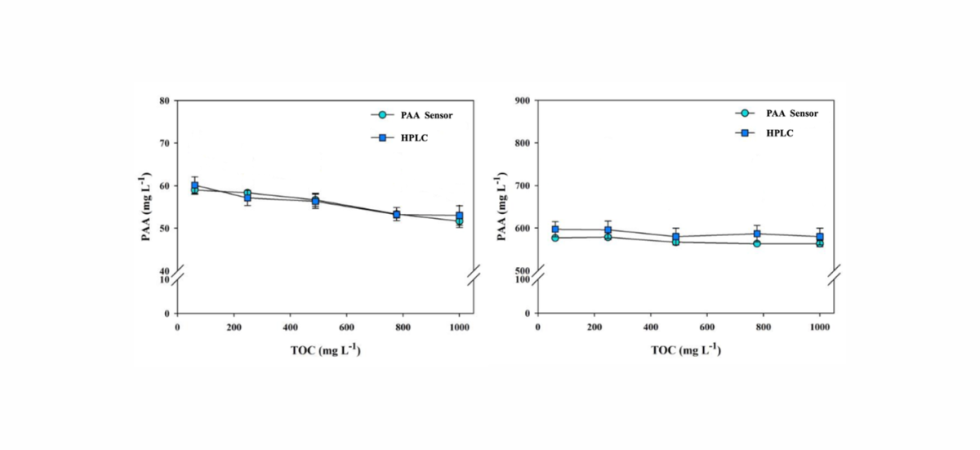
Summary graph of results from CEBAS-CISC PAA study. Study shows results obtained using the Kemio PAA Sensor method were similar to laboratory HPLC methods irrespective of the level of organic contamination up to 1000 mg/L TOC.
It is well known that temperature has a significant effect on peracetic acid detection, a fact that is overlooked in drop count kits. Kemio sensors can detect PAA concentrations over a very wide range of concentrations (from 0.02 – 2000 ppm) and temperatures (41°F – 86°F). Each batch of Kemio sensors is accompanied with a calibration curve plotted over three dimensions – current, concentration and temperature. All you need to do is scan the QR code for each batch of sensors and the corresponding calibration curve will automatically load onto the instrument.
PAA drop count kits have a series of complicated steps that you must complete to perform the test correctly. These steps vary based on the PAA concentration being tested, with separate steps for low range (20 – 90 ppm) and high range (300 – 500 ppm) detection.
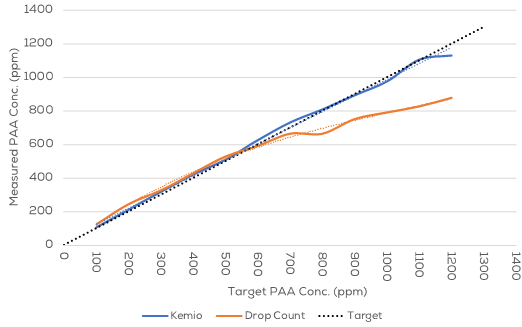
If the user does not adjust the dilution process based on low or high range detection, the standard process of 1 drop = 15 ppm would result in the readings plateauing when concentrations exceed 600 ppm, which is common in finishing chillers. By the time you discover a plateau, you may have been overdosing for an extended period of time.
Internal comparisons to regular range drop count kits show that Kemio continues to respond accurately even with high concentration samples, preventing costly overdosing from going undetected.
Summary graph of internal study showing a regular range drop count kit response plateauing when sample concentration exceeds 600 ppm whereas Kemio maintains accuracy.
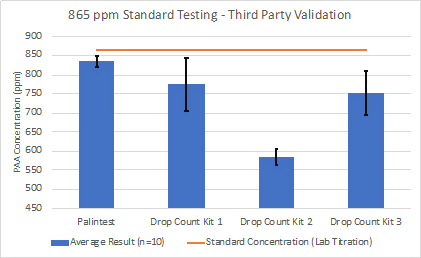
Unsurprisingly, drop count kits from different brands produce different PAA readings. A comparison of readings obtained from Kemio and three different drop count kits depicted a vast difference in PAA levels.
The variation in detection levels can be attributed to procedural differences between the kits. For example, some drop count methods do not account for hydrogen peroxide (uncatalyzed kits) whereas others do (catalyzed kits).
It cannot be ignored that drop count kits are extremely vulnerable to errors. Improper calibration, interference from hydrogen peroxide, insufficient titrant quantity for the test and operators rushing are just some of the challenge’s experienced when using drop count kits.
Benefit 2: Kemio offers unrivalled repeatability and traceability
One of the most significant advantages of Kemio is that you get consistently accurate results irrespective of the user. It does not matter what the skill level of your operator is, or whether they have performed a PAA test before, Kemio will give repeatable results for every user.
Benefit 3: Kemio is extremely user-friendly and designed for simplicity of use
Unlike traditional measurement techniques, Kemio is truly simple to use and guides the user with visual on-screen instructions, minimising chances for errors caused by users. Kemio requires no special training for operation and can be used by anyone straight out of the box. Several short YouTube videos are available (English & Spanish) that will give you all the information you need to successfully run a PAA test.
Benefit 4: Kemio requires no maintenance & or complex calibration procedures
Kemio uses disposable and cost-effective single use amperometric sensors. Each sensor is used only once, so there is no potential for spoiling or calibration drift. Furthermore, each batch of Kemio sensors are pre-calibrated at various PAA concentrations and temperatures. The resulting data is fit to a curve which is then loaded onto the instruments via the unique QR code associated with the sensor batch. With pre-loaded calibration data, Kemio sensors are completely calibration free for the operator. A critical step required in drop count kits is the need to adjust pH.
Strong acids like sulfuric acid are often used to achieve pH adjustment presenting a hazard to the user. Additional chemicals in the form of indicators and titrants are also needed to conduct the test. However, Kemio sensors come pre-fabricated with pH buffers and reagents, which are automatically released per the sample requirement. This eliminates the need for chemical handling, creating a hassle-free test environment perfect for QA teams and operators with busy schedules.
Benefit 5: Kemio is unaffected by colour, turbidity, hydrogen peroxide or organic load of the sample
Kemio relies on electrochemical detection of analytes, so it is not affected by the colour, turbidity, hydrogen peroxide concentration or the organic load of the sample – all of which can be present at significant quantities on poultry processing water, especially in recirculating pre-chillers. The impact of pH and temperature are taken care of in the pre-fabricated sensors. Drop count methods on the other hand can be severely affected by these factors, giving potentially faulty readings if the sample is not up to par. Ideal for users who use more than one disinfection type, Kemio Disinfection enables testing of bromine, chlorine, chlorine dioxide, chlorite and peracetic acid (PAA) on one device, using different sensors.
Benefit 6: Kemio is completely safe for the operator, requiring no glassware or chemicals
A minor accident while using a drop count kit can result in spilled acid, stained clothing or worse. Large volume refill bottles increase the hazard significantly. If an accident occurs at a food processing plant this may require production down time, a thorough cleaning of the incident area and may even cause injury to a team member. At Palintest, the health and safety of employees is the top priority. Kemio units do not require the use of dangerous chemicals or glassware for conducting tests and sensors do not require special waste streams.
Kemio creates a protected and auditable dataset, with automatic results logging. All the data is stored on the instrument and can be exported, eliminating the need for maintaining paper records. Results are tagged with the batch numbers, date, time, operator and sample IDs. To view our Kemio instructional videos click here.
Where drop count methods involve complex step-by-step processes for dilution, pH adjustment, titration and calculation, Kemio follows a straightforward 4-step procedure. Simply scan the sensor, fill the sample vessel, insert the sensor and close the lid. With results available in 60 seconds, Kemio enables you to take immediate corrective active where required. Kemio’s ease of use and on-screen results that do not require interpretation mean that Kemio’s accuracy and precision are not just ‘potential’ but are truly achievable, even in the most challenging operating environments.
Using Kemio to optimise PAA use, improving safety and cost efficiency
When it comes to PAA testing in the poultry industry, timely and accurate results are the two things that matter most. Our next-generation sensor technology, Kemio, delivers unbeatable accuracy and precision ensuring food safety while optimising chemical dosing.
Whether it’s saving on overdosing or reducing labour on testing, Kemio not only makes life easier but delivers meaningful financial value and ROI, Portable, fast and hassle-free Kemio technology delivers on all things that matter and more.