Free And Combined Chlorine – Understand The Difference
Understanding the difference between free and combined chlorine is crucial to understanding water quality after chlorination. Testing the water for both free and combined chlorine allows you to know whether the water you’ve chlorinated is of sufficient quality to drink or disinfect your process, depending upon your application.
What is the difference between free and combined chlorine?
Pure chlorine exists as a molecule as a gas (Cl2 ) and when dissolved in water it will react with water to form mostly hypochlorous acid (HOCl):
Cl2 + H2O ↔ HCl + HOCl
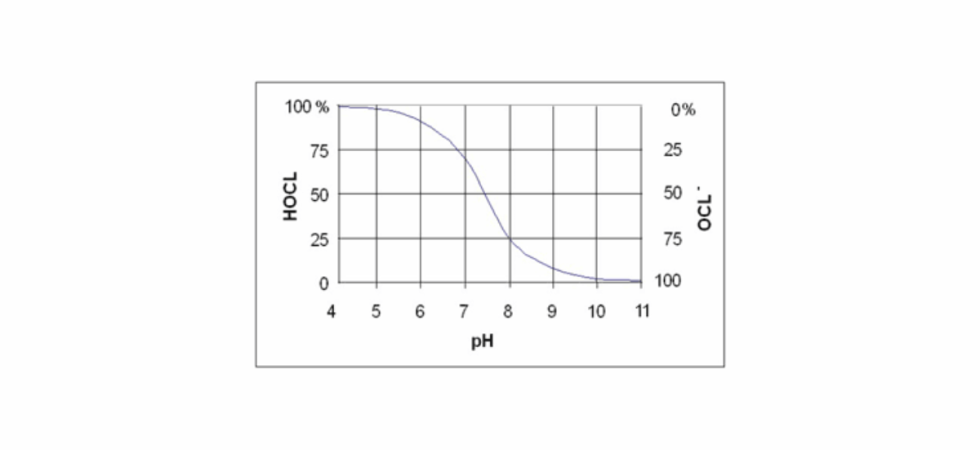
Depending on the pH of the water (see image right), the hypochlorous acid (HOCl) will partially dissociate to the hypochlorite ion (OCl–). Both hypochlorous acid and hypochlorite disinfect water but hypochlorous is acid is a more effective disinfectant.
By definition, free chlorine refers to all chlorine present in the water as Cl2(g), HOCl(aq) and OCl–(aq).
Portable water testing methods such as DPD do not distinguish between these three species, and they are all termed free chlorine, with the capability to disinfect microorganisms in the same way as Cl2. Free chlorine will often be denoted as Cl2 in water treatment applications and literature, but can refer to any of the three forms.
When free chlorine is initially added to water it can undergo a very quick reaction with other contaminants in the water, mostly ammonia, NH3. This will result in the formation of chloramines, and the ‘free’ chlorine is converted to ‘combined’ chlorine:
For the most effective monitoring of free and total chlorine, we recommend Kemio Disinfection. The latest multiparameter platform from Palintest, the Kemio Disinfection tests for bromine, free chlorine, total chlorine, chlorinedioxide, chlorite and peracetic acid (PAA).
Giving repeatable and reliable results for free chlorine in 60 seconds, Kemio guides the user and prompts action when concentration levels fall outside of your defined limits.
Share this article with your connections
Sign up for our newsletter
Please add your details below to receive our monthly newsletter and latest offers.
Related News
From Abattoir to Cold Store: Disinfection Monitoring Across UK Protein Processing and Food Logistics
21st Apr 2026
Read article
Disinfection Monitoring in UK Dairy Processing: Managing the Chemistry That Keeps Milk Safe
21st Apr 2026
Read article
Disinfection Monitoring in UK Beverage and Bottling: Protecting Product Quality at Every Stage
21st Apr 2026
Read article
Post-Harvest Disinfection Monitoring in UK Fresh Produce: How PrepWorld Eliminated 12 Hours of Daily Downtime
Palintest
600 Corporate Circle
Suite F
Golden Colorado
80401
USA
Manage Consent
To provide the best experiences, we use technologies like cookies to store and/or access device information. Consenting to these technologies will allow us to process data such as browsing behavior or unique IDs on this site. Not consenting or withdrawing consent, may adversely affect certain features and functions.
Functional
Always active
The technical storage or access is strictly necessary for the legitimate purpose of enabling the use of a specific service explicitly requested by the subscriber or user, or for the sole purpose of carrying out the transmission of a communication over an electronic communications network.
Preferences
The technical storage or access is necessary for the legitimate purpose of storing preferences that are not requested by the subscriber or user.
Statistics
The technical storage or access that is used exclusively for statistical purposes.The technical storage or access that is used exclusively for anonymous statistical purposes. Without a subpoena, voluntary compliance on the part of your Internet Service Provider, or additional records from a third party, information stored or retrieved for this purpose alone cannot usually be used to identify you.
Marketing
The technical storage or access is required to create user profiles to send advertising, or to track the user on a website or across several websites for similar marketing purposes.